
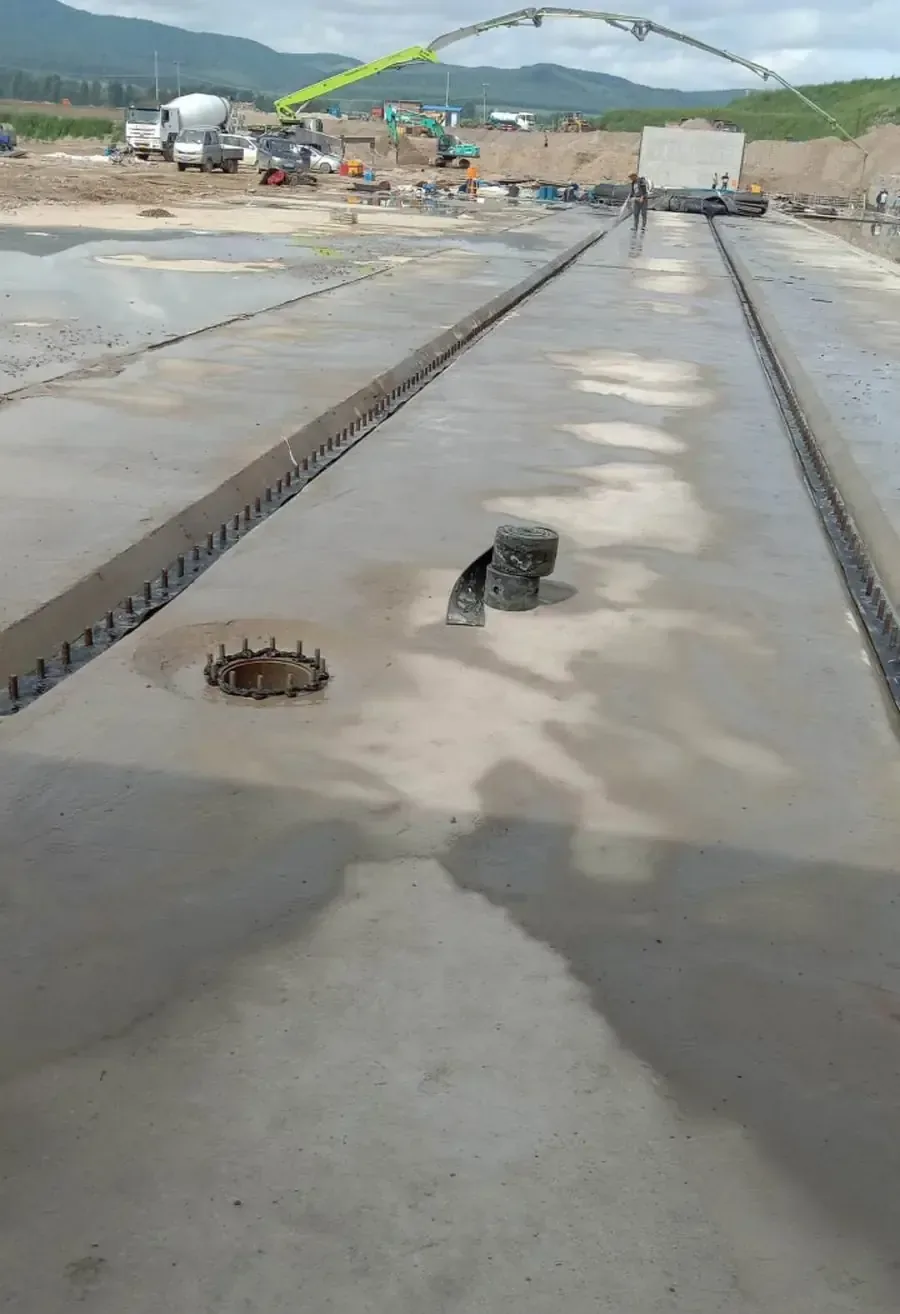
Rubber Dam Installation
Most of what decides whether a rubber dam installs cleanly is settled before the bag arrives: the sill geometry, the anchor bolts, and the route the bag takes into position.
Why a Rubber Dam Fits This Duty
A rubber dam is a flexible component bolted to a rigid foundation. The bag can be perfect and the installation still fail if the sill is out of level, the anchor bolts are out of line, or the anchor plates do not seat flat. That is why the interface is reviewed before the concrete is poured, not after.
Installation is therefore a sequence with hold points: survey, foundation check, anchoring, bag placement, inflation test, control commissioning. Each one is signed off before the next begins, because correcting an anchorage after the bag is in place is a very different job from correcting it beforehand.
The work is carried out by the manufacturer's own installation teams, who have done it on rivers from narrow canal off-takes to multi-hundred-metre spans.
How It Works in Practice
Site survey and interface review
River bed profile, flow conditions, access and the sill design are checked against the drawings. Anchor positions and embedded parts are confirmed before the civil works proceed.
Foundation and anchorage
The sill is checked for level and finish; anchor bolts, clamp plates or wedge anchors are set to the specified line and spacing. This is the step that decides how the bag sits for the rest of its life.
Bag placement
The bag is positioned, aligned and fixed along the anchorage. Folds and twist are controlled during placement so the bag inflates evenly across its full width.
Inflation test and commissioning
The bag is inflated and deflated through its full range, the air or water system is tested, and the control logic is set against the operating levels agreed with the owner.
Training and handover
The site team is trained on normal operation, seasonal procedures and the checks that belong in a maintenance routine. Drawings and operating instructions are handed over with the dam.
Choosing the Configuration
The installation plan depends on the site, not on a standard template: a river that can be diverted, a canal that can be shut down, and a live channel each need a different sequence and a different temporary works arrangement.
If you are at design stage, send the drawings before the foundation is poured. Reviewing the anchorage interface at that point is the single cheapest way to avoid problems at installation.
Common Questions
Installation is carried out by our own teams, and the arrangement — duration, scope and who provides what — is agreed with the owner before the contract.
Access to the sill, the civil works complete to the agreed drawings, power and water at the control chamber, and a site team available for training and handover.
Related Pages
- Rubber Dam Engineering — The structure being installed.
- Rehabilitation — Replacing a bag on an existing dam.
- Talk to an Engineer — Send drawings for an interface review.
Tell Us About the Site
Send the river width, the level you need to hold and the flow you must pass — our engineers will come back with a proposed configuration.