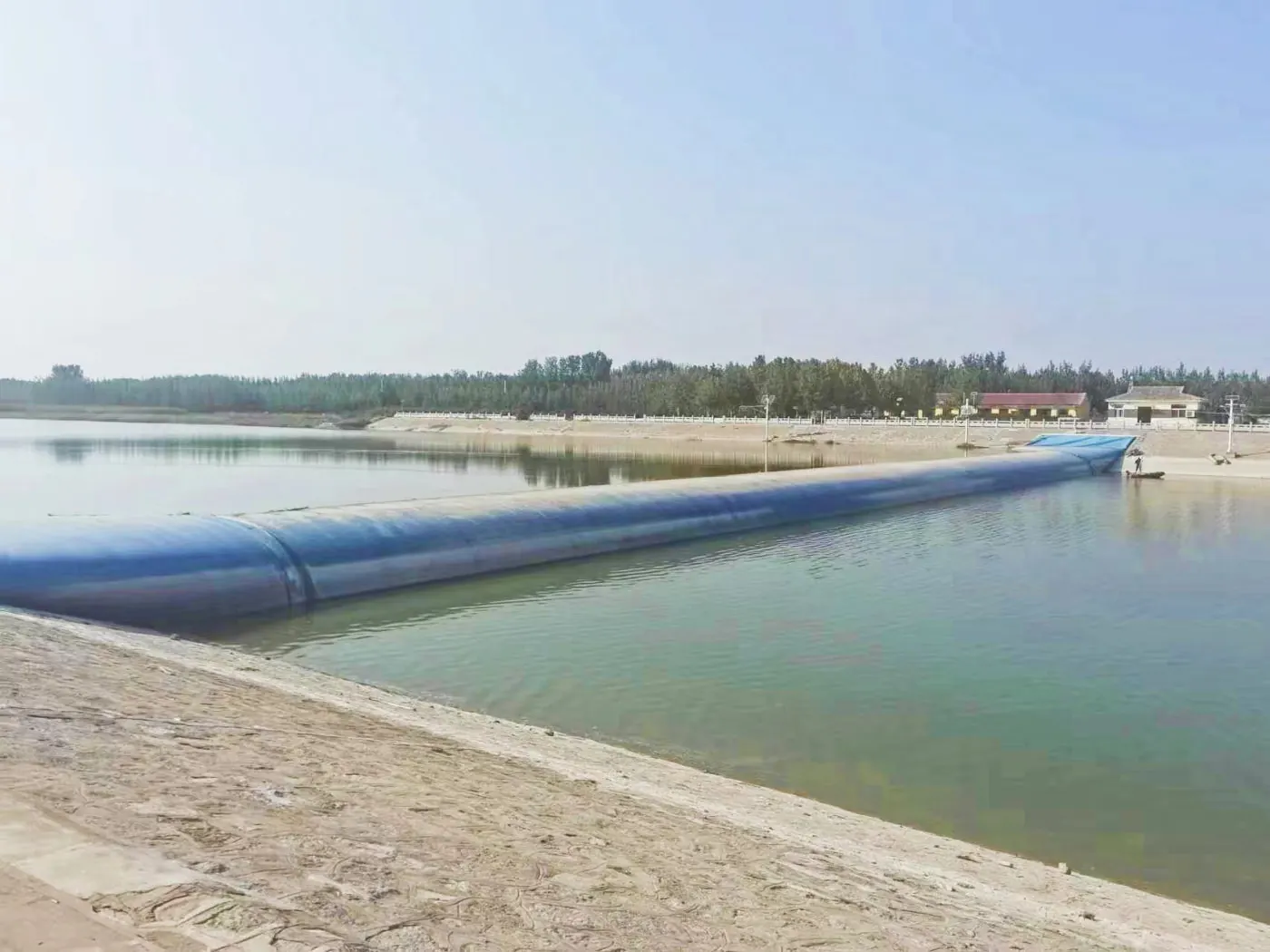
The questions hydraulic design institutes, contractors and project owners ask us most — selection, customization, anchoring, installation and service.
Choose the air-filled type for fast lifting, lower construction cost, lower energy consumption and no icing risk. Choose the water-filled type for stable operation through self-weight damping and better winter performance. Both are the same inflatable weir principle — a reinforced rubber bag clamped to a concrete sill — and both cover a water-retaining height of 0.5–6 m. Send us your hydrological data and we will recommend the right one — see the water-filled vs air-filled rubber dam comparison for the full list of differences.
Yes. Height from 0.5 to 6 m, span, dam bag colour and the anchoring method (bolt or wedge anchoring, single-row or double-row) can all be tailored, with a matching dam bag model and anchoring parts. Full-range custom-built dam bags with individual specifications, tensile strength and colour are normal orders for us, not exceptions.
Standard dam bags cover 0.5–6 m — see the rubber dam specification selector. Because the 32 m seamless vulcanizer can fabricate bags up to 7.5 m high in a single piece without longitudinal seams, higher requirements are engineered case by case rather than being capped by a catalogue.
Bolt anchoring — upper and lower pressure plates clamp the dam bag while embedded bolts fix the assembly to the foundation. Wedge anchoring — a wedge plus wood core compresses the bag into the anchoring groove for fast disassembly and easy maintenance. Both are available as single-row or double-row. Pressure plate dimensions are confirmed per project against the design dam height — the standard arrangements are shown in the rubber dam spec selector and the brochure (PDF).
Up to 4.0 m we normally use a 2-ply fabric with 3 rubber layers (2F+3R). From 4.5 m upward the structure moves to 3-ply fabric with 4 rubber layers (3F+4R), because the internal pressure ratio rises with the water head and the canvas has to carry a higher tensile load. The exact combination is confirmed against the design water head, not by height alone.
A 32 m seamless vulcanizer with 13,738 t clamping force for one-piece large dam bags, a 2000T arc-forming press shaping plates up to 30 mm thick in a single pass, a fully automatic mixer centre guaranteeing identical compound batches, and a proprietary intelligent control system with three software copyrights — all backed by three-stage full-process inspection. See manufacturing capabilities.
Yes. A professional installation team follows a standardized 10-step procedure — from anchor pre-embedding and foundation preparation to bag unfolding, plate fastening and filling commissioning. We also advise scheduling the civil works for the dry season, when a low river makes the foundation, sill and anchoring work safer and faster. Before delivery, the specifications, performance and quantity of all materials are comprehensively inspected and an inspection certificate issued. After-sales technical support covers both domestic and overseas projects, including free technical consultation and free installation guidance; for on-site service missions the customer covers travel, food and accommodation. See the installation sequence.
Yes. Pressure plates are formed in-house from cold-rolled steel and hot-dip galvanized; embedded bolts and U-bolts are produced in-house, with sherardizing (zinc diffusion) for permanent underwater service. Because standard plate lengths of 996 / 998 mm and 200 mm bolt spacing are shared between rubber dams and air shield dams, upper and lower plates can be freely combined and replacement sets can be supplied independently of a new dam.
Over 132 projects across 22 Chinese provinces, municipalities and autonomous regions — including Tianjin, Shaanxi, Shandong, Henan, Jilin, Hebei, Xinjiang, Heilongjiang, Liaoning and Jiangxi. Benchmark references include Jiyun River (5.5 m, 120 m span), Ba River Xi'an (890 m) and Shanhaiguan (1,428 m). See reference projects.
Yes, this is one of the main applications of the air shield dam (pneumatically operated spillway gate). It can be applied directly to the transformation of existing rubber dams and automatic flap-gate dams. Because the steel shield plates take the water load, residual retention after full collapse is less than 9 cm and debris damage to the bag is eliminated. See air shield dam.
River width and the number of bays you have in mind, the design water-retaining height (0.5–6 m), the filling medium (water or air) and the anchoring method preference. Send them through the inquiry form and our engineers will reply with a technical proposal and quotation.
Prices are calculated per project from your technical parameters, because the bag area, canvas grade, filling medium, anchoring system, control scope, civil works and freight all move the number. The minimum price we quote is USD 120 per square metre; the exact figure is stated in a project-specific quotation. See the cost breakdown article.
Lead time is quoted per project rather than published as one fixed number of days: it depends on the order volume and the specification of the dam bags and equipment. The lead time for your scope is stated in the quotation and confirmed in the contract.
Routine inspection of the dam bag surface, the anchoring bolts and the filling and discharging system. The outer rubber cover is formulated for wear, sunlight and ozone resistance, and the rubber is tested for hot-air and hot-fresh-water ageing at 70 ℃ × 96 h plus ozone ageing at 10,000 pphm. The air shield dam reduces maintenance further, because the steel shield plates protect the bag from floating debris.
Installation quality is proven by a staged filling test with the contractor, designer, manufacturer and supervisor present. Water dams are first filled to no more than 50% of design height and held for at least 30 minutes while seals and anchors are checked, then to 80%, then to full design height with a 12-hour supervised water-retention test where conditions allow; anchor hardware is re-tightened after each deflation. Air-filled bags follow the same staging by pressure (50%, 80%, then design pressure). See our operation and maintenance guide for details.
In cold regions, drain the bag and its piping before the freeze and let the dam lie flat under a natural ice or snow cover for the winter. Where the dam must hold water through the freeze, cap the filling height at 80% of design height and keep a 20–30 m ice-free band on the upstream face. Do not adjust the dam height while ice stands — wait until the ice inside the bag has melted and the anchor line has been checked before inflating or deflating.
Send it to our engineering team — you will get a technical answer, not a sales brochure.