
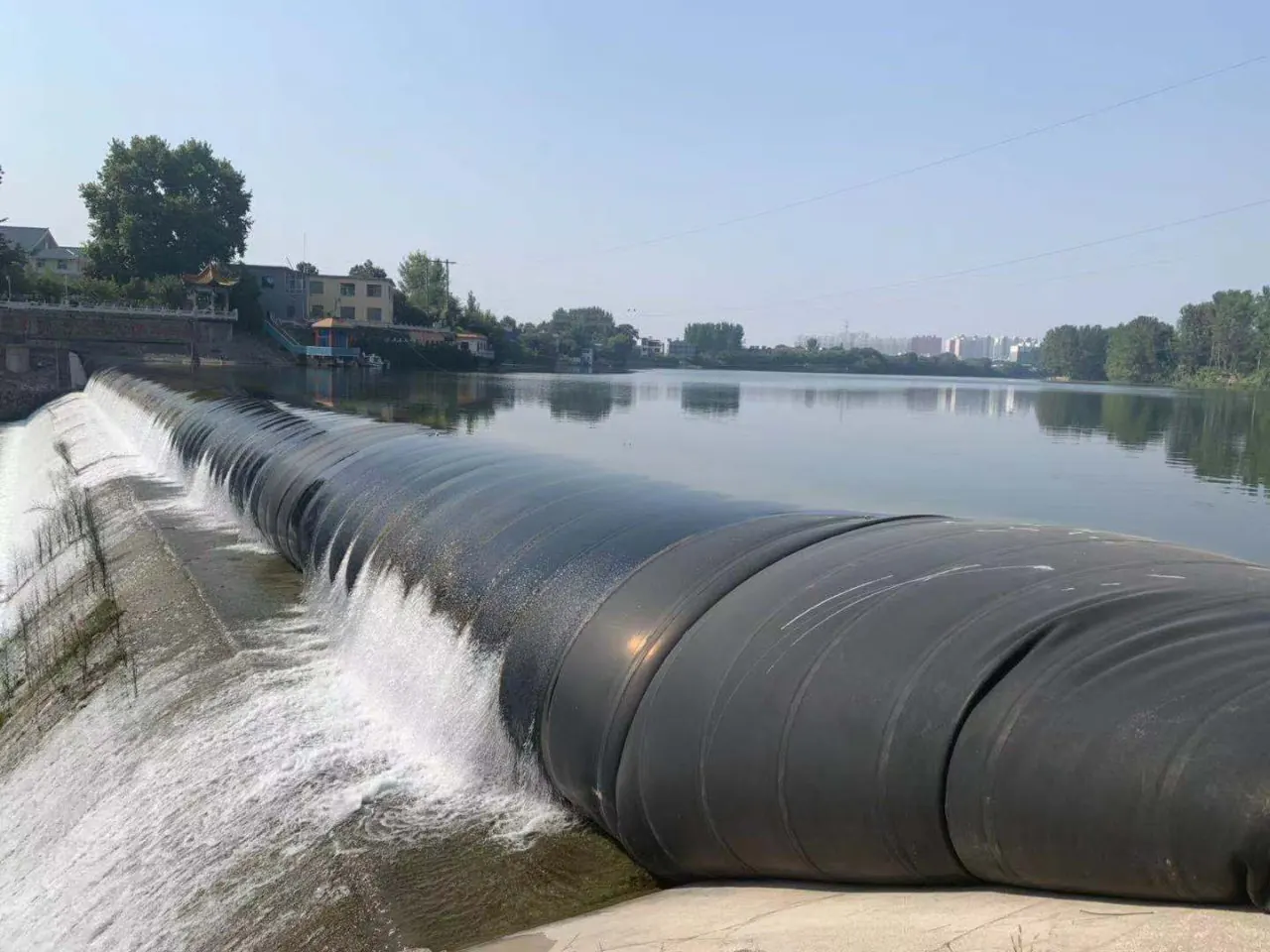
Every dam bag we ship is engineered against a specific river: a fixed water head, a fixed span, a chosen filling medium and a foundation that already exists or has yet to be poured. Two projects with the same height can differ in price by a factor of several, because height is only one of seven variables. This article lists them, gives you the one reference number we publish, and explains how lead time is confirmed.
Why rubber dams are quoted, not listed
A steel gate catalogue can list a gate, because a gate is a discrete object with a standard frame. A rubber dam is a system: dam bag, clamp plates, anchor bolts, filling and discharging equipment, controls, and the interfaces to civil works that the client builds. Change the head, the span, the medium or the foundation, and every one of those components changes with it. Publishing a single price per metre would be misleading for both of us — you would either budget too low and be disappointed, or budget too high and walk away from a viable project.
The seven cost drivers
| Driver | What changes with it |
|---|---|
| 1. Bag area (height × length) | The single largest factor: square metres of rubber-coated fabric. Bag height also decides the structure class — our standard JBD range covers 0.5–6.0 m, and the 32 m seamless vulcanizer can produce bags up to 7.5 m high in one piece. |
| 2. Canvas grade and ply structure | Grade ladder from J1010 (100 / 100 N/5cm per canvas ply) to J3636 (360 / 360); the finished 2-ply bag starts at 200/200 and the 3-ply tops out at 1080/1080 N/5cm. Bags above 4.5 m move from the 2-ply (2F+3R) to the 3-ply (3F+4R) structure because the vertical pull on the anchorage climbs from 60 t/m at 4.0 m to 75.9 t/m at 4.5 m and 117 t/m at 6.0 m. |
| 3. Filling medium | Water or air. Air needs a denser, tighter bag and a compressor/blower set; water needs pumps, valves and a pump house. The two systems differ in equipment scope, not just in the bag. See the water vs air comparison. |
| 4. Anchoring system | Single or double anchor line, plate length (standard 996 / 998 mm), bolt spacing (200 mm), bolt material and surface treatment — hot-dip galvanizing or sherardizing (zinc diffusion) for permanent underwater service. |
| 5. Control and automation | From manual valves up to an automatic control cabinet with level sensing, remote monitoring and the intelligent control system. Automation is usually a modest share of a project, but it is the part that determines operating labour. |
| 6. Civil works | The concrete sill, abutments and pump house are normally built locally by the client to our drawings — so they sit outside our supply, but they are inside your total budget. A flat, correctly levelled sill is also what the bag's service life depends on. |
| 7. Freight, packaging and site services | Dam bags are bulky and travel in plywood crates; cost depends on volume, destination port and container loading. Installation guidance, documentation and spare parts are quoted with the supply. |
The one number we do publish
Prices are calculated per project from your technical parameters, so the honest way to give you an anchor is a floor rather than a range: the minimum price we quote is USD 120 per square metre. Where a project lands above that floor depends entirely on drivers 2–7 above — a 6.0 m coastal bag with double anchoring and automation sits at a different level from a 1.5 m landscape weir.
How to use the reference price
Multiply it by your approximate bag area (retaining height × dam length) to sanity-check a budget range — then ask us for the real quotation, because that is the only number that reflects your river. Treat the result as a planning floor, not a quotation.
Lead time: quoted per project, confirmed in the contract
Delivery is quoted per project for the same reason as price. A single landscape bag and a multi-bay river scheme with automation are not built on the same schedule, and we will not put a fixed number of days on a page that a very large order cannot meet. In practice: the lead time is stated in the quotation for your specific scope and confirmed in the contract, and we hold to that date rather than to a marketing figure.
Getting a firm quotation in one round
Send these six items and our engineers can return a technical proposal with quantities, drawings and price — without a second round of questions:
- River width and the number of bays you have in mind
- Design water-retaining height (0.5–6.0 m standard range)
- Filling medium preference — water or air
- Foundation condition: new concrete slab, or an existing structure to be reused
- Destination port and required quantity
- Any design drawings, hydrology data or tender documents you already hold
Send your river data — get a real number
Width, height, medium and foundation are enough for a first proposal. Bag structures, anchoring parts and the full model range are on the rubber dam page.