
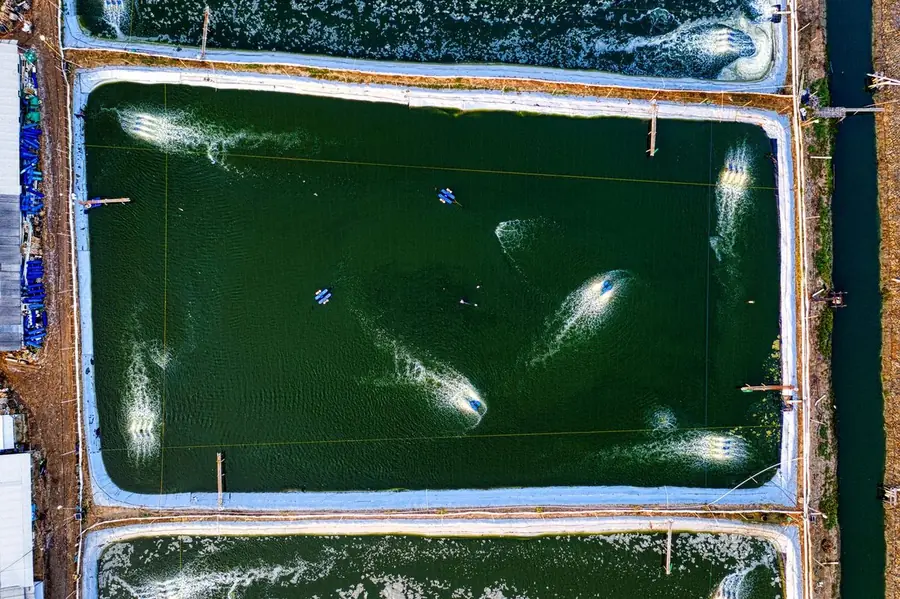
Rubber Dams for Aquaculture
Fish need depth held inside a narrow band. A rubber dam holds that band quietly, and gives it up in stages when the pond has to be worked.
Why a Rubber Dam Fits This Duty
Aquaculture is sensitive to level swings. A drop of a few tens of centimetres changes temperature, dissolved oxygen and stocking density all at once. A fixed weir cannot respond; a bag can be trimmed to hold the band the stock was planned around.
Harvest, grading and pond cleaning all need the water down, but not the whole reach dry. Because the dam works in bays, one section can be lowered while the rest keeps holding, so the operation moves along the farm instead of stopping it.
Water exchange is the third duty. Raising the bag holds the reach; lowering it lets fresher water in from upstream and flushes the older water out, which is cheaper than pumping.
How It Works in Practice
Holding depth
The bag maintains the upstream level against a set-point, so the pond or cage zone keeps its designed depth through dry spells and low-flow periods.
Staged drawdown
Bays are lowered one at a time, so the water goes down where the work is happening and stays up elsewhere.
Water exchange
Deflating the bag restores the natural gradient and allows a controlled exchange, then the level is rebuilt.
Low-disturbance operation
There is no gate leaf or machinery in the water to injure stock, and the bag presents a smooth surface to the flow.
Choosing the Configuration
Where the level has to change often and precisely, an air-inflated bag or an air shield dam is the better fit; where the priority is a long, low-cost span holding a steady level, water inflation is usually enough.
The design inputs are the depth band the stock needs, the range of river flow, and how often the reach is drawn down. Those set bag height and the number of independently controlled bays.
Common Questions
Yes. Bays operate independently, so drawdown can be limited to the section being worked.
The bag itself is inert rubber; it adds no coating or leachate to the water. Holding a pool can reduce velocity, so the operation plan should include periodic exchange and sediment flushing.
Related Pages
- All Applications — See the other seven duties.
- Rubber Dam Engineering — Bag and anchorage construction.
- Ask an Engineer — Send your depth band and flow range.
Tell Us About the Site
Send the river width, the level you need to hold and the flow you must pass — our engineers will come back with a proposed configuration.