
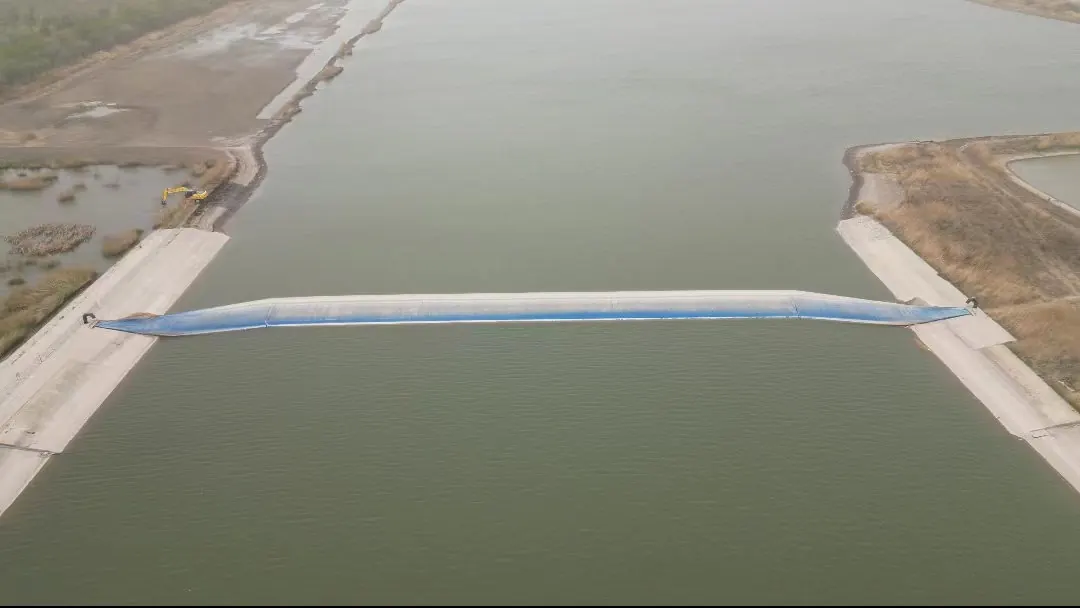
Not every rubber dam works on a mountain river with a clear flood season. The Jiyun River dam in Tianjin is the opposite case: a coastal plain river in the Haihe basin, tidally influenced, crowded with irrigation intakes — and renewed with a single-span Baoli dam bag. It shows what the upper end of the JBD range is actually built for.
The river’s problem: a salt tide with no gradient to fight it
The Jiyun is a plain river near the Bohai coast with almost no gradient. At high tide, sea water pushes up the channel; every dry-season upstream withdrawal lets the salt wedge travel further inland, threatening irrigation intakes and groundwater. A dam here has to do two jobs at once — hold a fresh-water pool deep enough to override the tidal wedge, and still pass flood flow without raising upstream levels on a river that has no drop to spare.
That combination is exactly what a deflatable bag buys you. The 5.5 m crest holds the storage pool that repels the salt tide; in flood, the bag simply deflates and the whole channel opens. A fixed weir at the same height would have needed a costly bypass structure for floods — which is why deflatable dams are the preferred answer on plain tidal rivers.
What the 5.5 m class looks like in the design matrix
This project sits among the taller bags in the JBD range. In Baoli’s standard design matrix, the 5.5 m class is specified as follows — a useful reference for any comparable high-head, large-span tender:
| Parameter | 5.5 m Class Value |
|---|---|
| Dam bag model | JBD5.5-360360-3 |
| Layer combination | 3 fabric plies + 4 rubber layers |
| Nylon canvas specification | J3636 (360 / 360 N/5cm) |
| Bag warp / weft strength | 1080 / 1080 N/5cm |
| Internal pressure ratio | 1.15 |
| Internal pressure of water head | 6.32 m |
| Vertical pull force of dam bag | 98.30 t/m |
| Safety factor | 10.9× |
The 2-ply → 3-ply structure step at the 4.5–5.0 m classes follows the same JBD design rules — preview the standard configuration for your design height with the rubber dam specification selector on the Rubber Dam page.
Anchoring a line that pulls 98 t per metre
At 5.5 m of retaining height, the vertical pull on the anchor line reaches 98.30 t/m in the water-filled series. The standard 5.0–5.5 m anchoring schedule answers with the heaviest clamp line in the standard range:
- Upper pressure plate 996 × 200 × 22 mm, lower plate 998 × 220 × 12 mm
- Anchor bolts M36 × 1000, hot-dip galvanized, at 200 mm spacing
- Design safety factor of the anchorage > 3× the bag’s design tensile force
One detail matters on a single 120 m span: with no intermediate piers, the clamp line runs continuous along the full axis, so plate alignment and staged bolt tensioning decide whether the seal holds evenly across the whole span. The installation sequence — template drilling, staged torquing, staged first inflation — is covered in our installation sequence.
A renewal project, not a greenfield one
The Jiyun dam is also a benchmark because it is a renewal: a high-strength reinforced dam bag installed to renovate an existing dam on the same sill line. Renewal jobs constrain the design — the bag must match the existing anchor layout and sill geometry instead of the other way round — and they are a large share of the market in basins where first-generation dams are reaching the end of their service life. Full drawings and material test reports for comparable renewals are available on request.
Why this project matters to buyers
If your site is a plain tidal river — South and Southeast Asia delta rivers behave the same way — the question is never just “how high”. It is whether the dam can store enough fresh water to override the salt wedge and disappear completely in flood. A 5.5 m single-span renewal on a silted coastal river is direct evidence of both.
Planning a comparable project?
Tell us the river width, required retaining height and — critically for tidal sites — the salt-wedge extent and irrigation intakes upstream. We will send the design matrix rows for your height class, the anchoring schedule, and reference records from comparable projects. The project data sheet for this dam is on the Jiyun River project page.
Get the 5.5 m class data pack
Design matrix rows, anchoring schedule and reference drawings for comparable high-head, large-span and renewal projects — available on request.