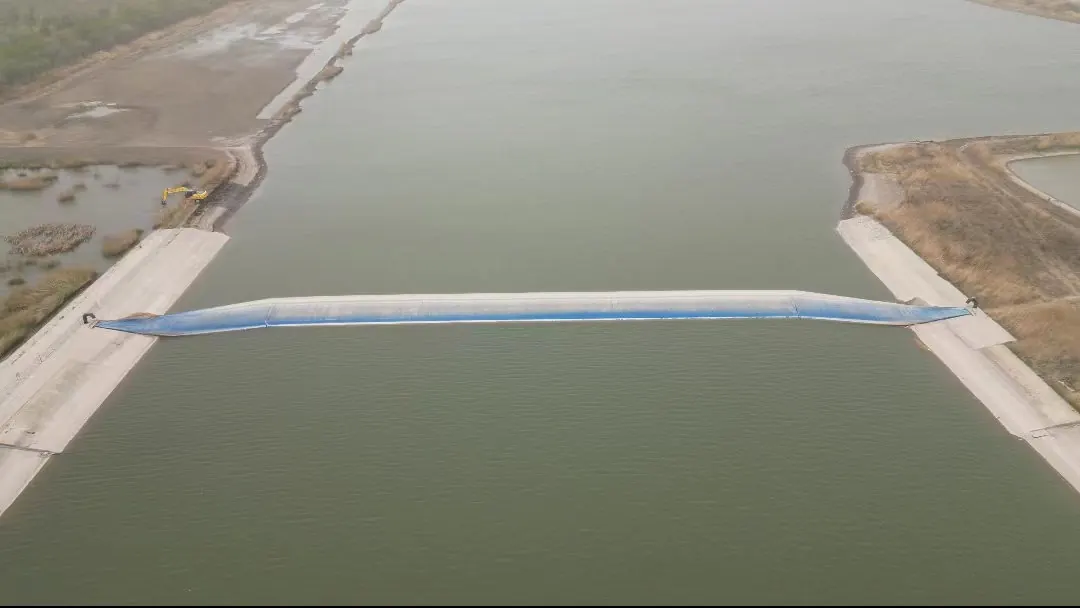
5.5 m water-retaining height · 120 m total length · North China
| Project name | Jiyun River |
|---|---|
| Project location | Jiyun River, Tianjin, China |
| Region | North China |
| Dam type | Rubber dam — fabric-reinforced inflatable dam bag |
| Dam design | Baoli (in-house design & manufacture) |
| Water-retaining height | 5.5 m |
| Spans / openings | 1 |
| Max single span | 120 m |
| Total length | 120 m |
| Application | Flood control · Water storage · Salinity prevention |
| Dam bag series | JBD series, 0.5–6 m height range |
| Drawings & test reports | Available on request |
High-strength aramid-reinforced dam bag adopted for the renovation of an existing dam. Delivers flood control, water storage and salinity prevention for the Haihe River basin. The large-span integrated design ensures stable operation and tight sealing — a benchmark renewal project for rubber dams in northern China.
Water-retaining height
Total dam length
Spans / openings
Project region
The Jiyun is a plain river near the Bohai coast with almost no gradient. Sea water pushes up the channel at high tide, and every dry-season upstream withdrawal lets the salt wedge travel further inland, threatening irrigation intakes and groundwater.
The dam works here as a salt barrier as much as a storage weir. Its 5.5 m crest — among the taller bags in the JBD range — holds a deep fresh-water pool that over-rides and repels the tidal wedge. A fixed weir at the same height would have needed a costly bypass structure for floods; a deflatable bag simply lies down and lets the river through, which is why deflatable dams are the preferred answer on plain tidal rivers.
A bag of this height is not filled in a single pass. Internal pressure rises faster than the bag's shape can settle, and a fast fill can leave the fabric creased where it meets the clamp line. The bag is raised in steps instead, pausing at each step so the shape can even out, with the crew watching the seals and the anchor line while it holds. Each step is short; the whole sequence is not, and that is the point of it.
Salinity control is a scheduling problem as much as a structural one. Through the dry months the bag is held at its working head, keeping a body of fresh water in the reach and holding the salt wedge at the river mouth below the intakes. When the wet season arrives the dam is deflated and the reach is flushed at full section. One bag therefore stores water in the dry season and keeps salt out of the supply in the same season, simply by how far it is filled.
This reference project used our rubber dam system — fabric-reinforced dam bag with bolt or wedge anchoring, water-filled or air-filled operation.
Considering an air shield dam instead? Compare the two systems before you specify.
We can share detailed drawings, material test reports and owner contacts for projects comparable to yours.
Tell us your river width, required water-retaining height and site conditions — we will send comparable project records and a preliminary configuration.