
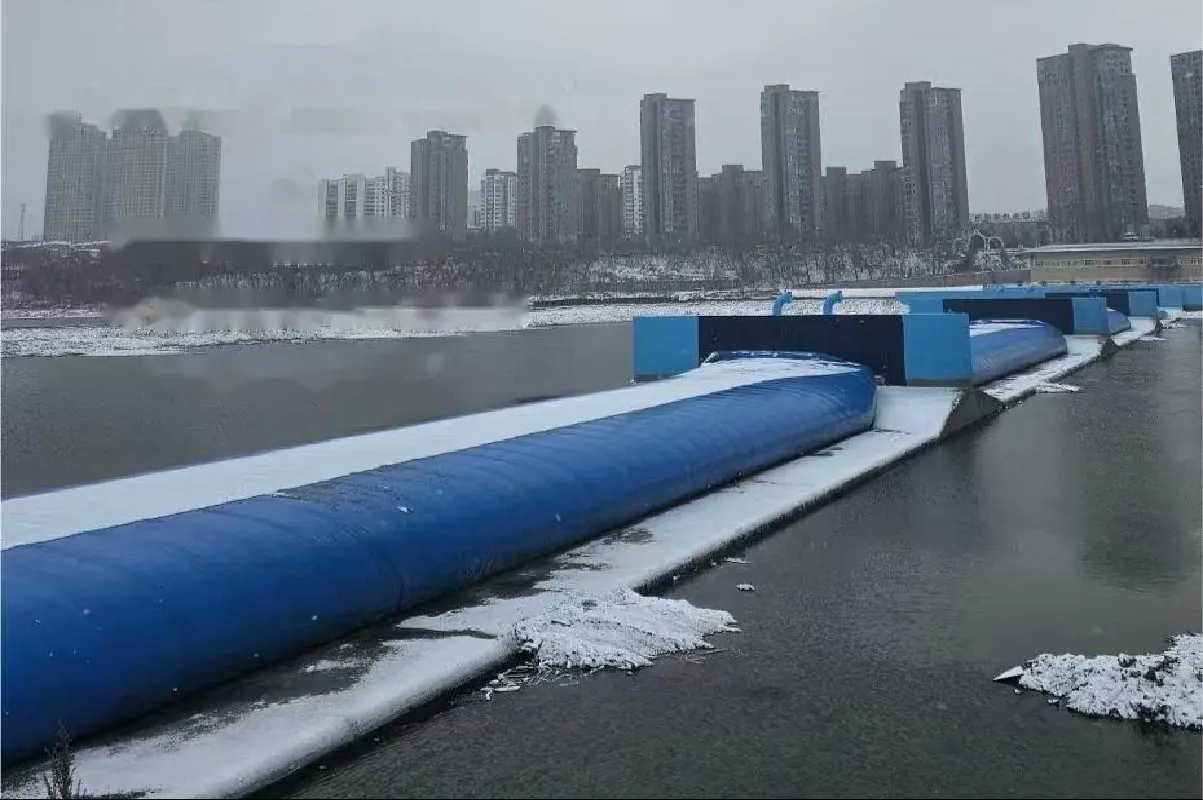
Cold-region operation is the test that separates a real dam bag from a fair-weather one. The Songhua River dam in Jilin works at 5 m of retaining height across 260 m of one of China’s great continental rivers — flood control, water regulation and an urban waterfront landscape, through freezing winters and a violent spring ice run.
What a continental river demands
The Songhua is a continental-scale river: wide, powerful in flood, and ice-covered for a large part of the year. Any dam in its channel must pass enormous flows without raising upstream levels — on a river this size, anything less than total opening would push backwater into upstream cities — and it must survive the spring ice run and year-round sediment movement.
This is the case for a fully deflatable crest. In flood, the entire 260 m line lies flat and the river takes its whole channel back. The dam then reinflates to re-form the regulation pool that the city’s waterfront and intakes depend on. No gates to hoist, no machinery on the crest, no obstruction when the river is at its most dangerous.
The 5 m class in the design matrix
At 5 m, this dam sits in the upper reaches of the JBD range, where the bag structure steps up from 2-ply to 3-ply fabric. The standard 5.0 m class values:
| Parameter | 5.0 m Class Value |
|---|---|
| Dam bag model | JBD5.0-330300-3 |
| Layer combination | 3 fabric plies + 4 rubber layers |
| Nylon canvas specification | J3330 (330 / 300 N/5cm) |
| Bag warp / weft strength | 990 / 900 N/5cm |
| Internal pressure ratio | 1.20 |
| Internal pressure of water head | 6.00 m |
| Vertical pull force of dam bag | 87.50 t/m |
| Safety factor | 11.3× |
The 2-ply → 3-ply step between the 4.0 and 4.5–5.0 m classes follows the same JBD design rules — try the rubber dam specification selector on the Rubber Dam page to preview the standard configuration for your design height.
Winter is the design case, not the exception
Ice is handled the northern way: the dam is deflated flat before freeze-up, and the bag spends the winter protected under the ice sheet. The material standard backs this up — the rubber compound is required to pass a low-temperature impact test at −30 °C in every layer, alongside hot-air and hot-water ageing, ozone resistance and abrasion requirements, so a bag that folds flat in a Jilin January is a tested condition, not an assumption.
When the ice run comes in spring, the dam is already down: sheets of ice pass over the lying bag instead of loading a standing crest. This “winter lay-up” strategy is the standard cold-region operating pattern for inflatable dams and the reason they are widely chosen for Northeast China, Mongolia-facing basins and continental-climate rivers elsewhere.
Holding 87 t per metre of anchor line
The 5 m class pulls 87.50 t/m vertically on its anchor line in the water-filled series. The standard anchoring schedule for the 5.0–5.5 m band:
- Upper pressure plate 996 × 200 × 22 mm, lower plate 998 × 220 × 12 mm
- Anchor bolts M36 × 1000, hot-dip galvanized, at 200 mm spacing
- Anchorage designed above 3× the bag’s design tensile force
Across 260 m of dam axis that clamp line runs a very long way — which is why template drilling and staged bolt tensioning along the row, not just at the ends, decide the seal. The full site sequence is in our installation sequence.
Why this project matters to buyers
If your river freezes — continental-climate basins in Central Asia, North China, Mongolia-facing regions, high-altitude rivers — ask for two things: the compound’s brittleness temperature certificate, and the supplier’s winter operating protocol. A 5 m × 260 m dam entering its winters under the ice sheet on a river of this scale is direct evidence of both.
Planning a cold-region project?
Send us the river width, retaining height, ice regime and flood requirements. We will share the design matrix rows for your height class, the anchoring schedule, the material test standard, and reference records from comparable cold-region projects. The project data sheet for this dam is on the Songhua River project page.
Cold-region data pack on request
Design matrix, anchoring schedule, material standard with −30 °C brittleness requirement, and reference drawings for comparable ice-regime projects.