
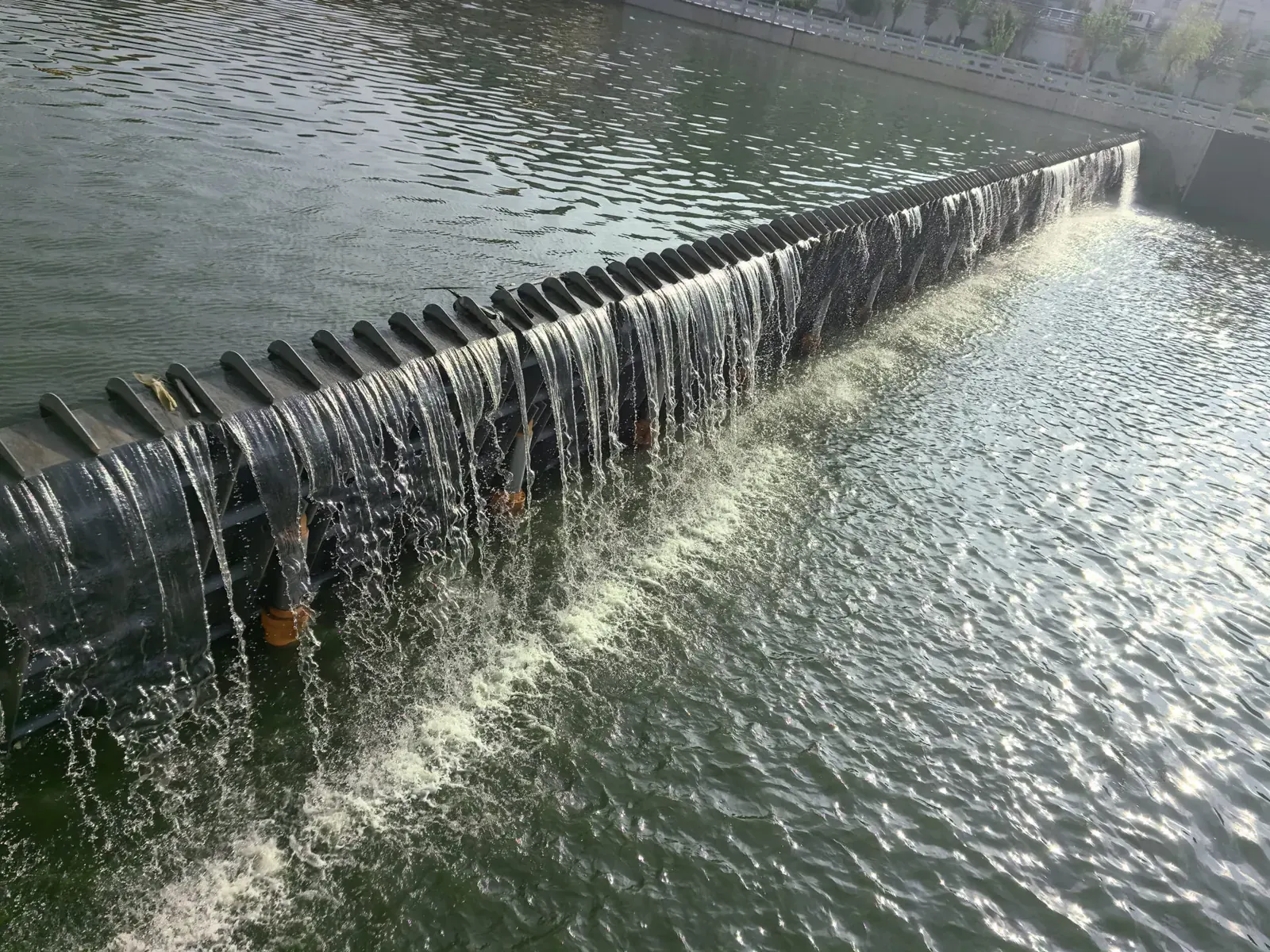
On a plain river, the question is rarely “rubber or steel?” in the abstract — it is what your cross-section demands. A rubber dam (inflatable weir) and a steel gate solve the same problem with completely different mechanics, and the economics diverge fast once the river gets wide.
How each system works
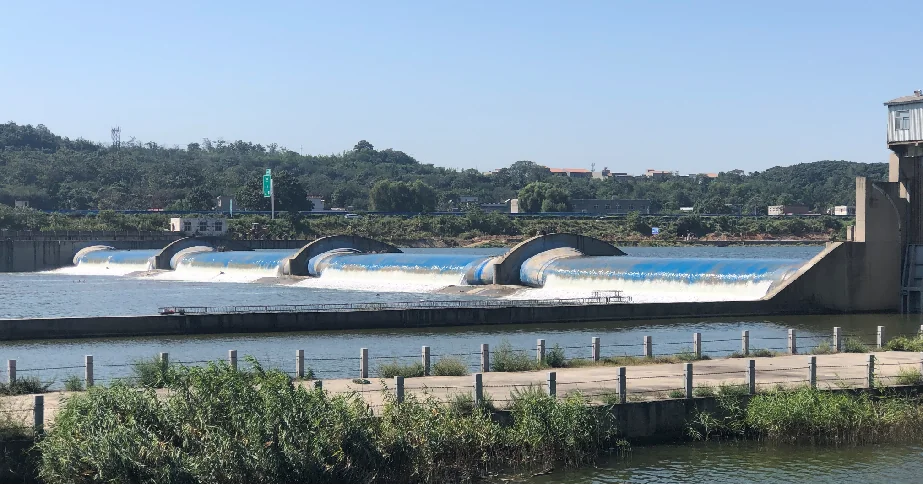
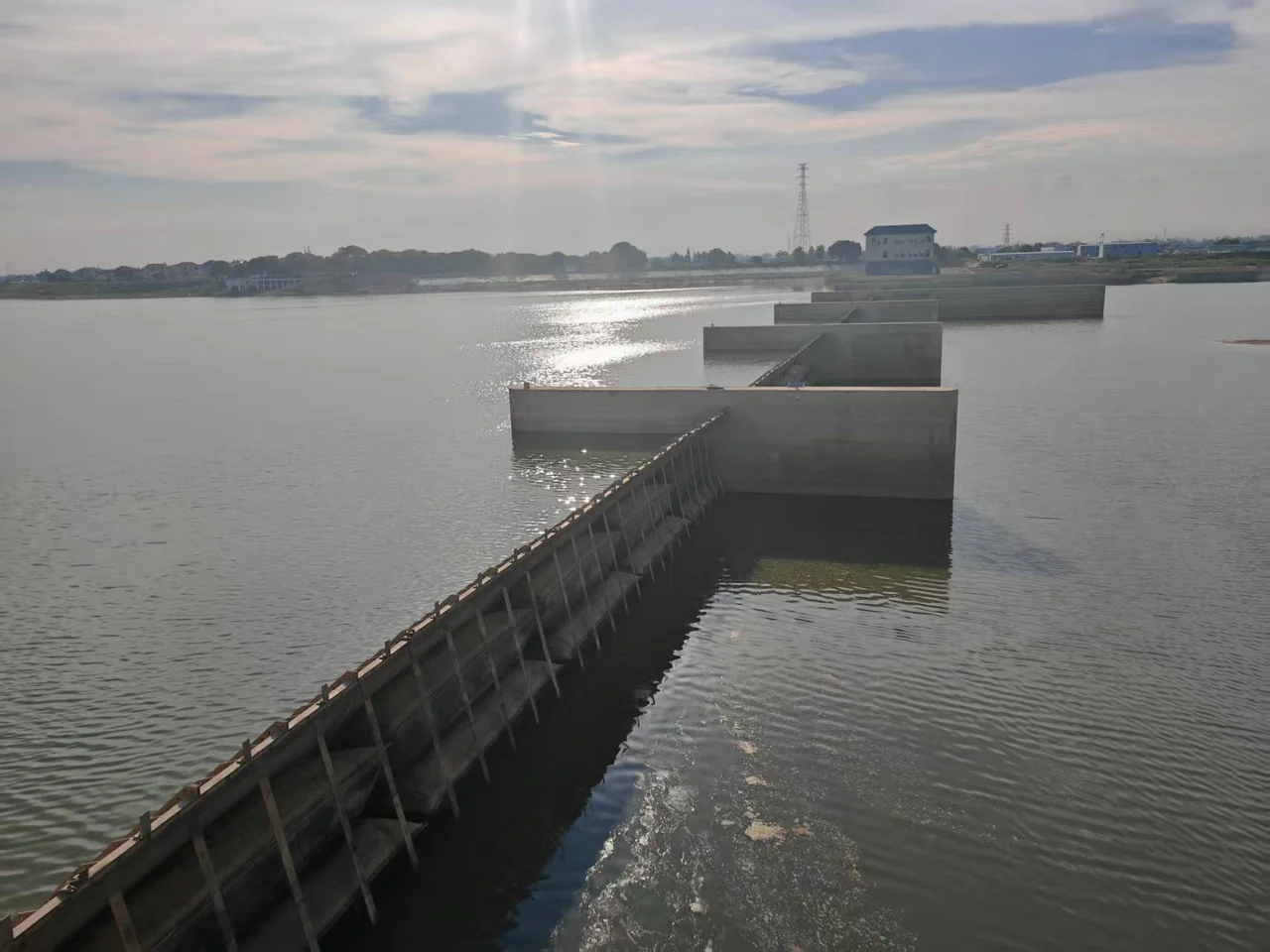
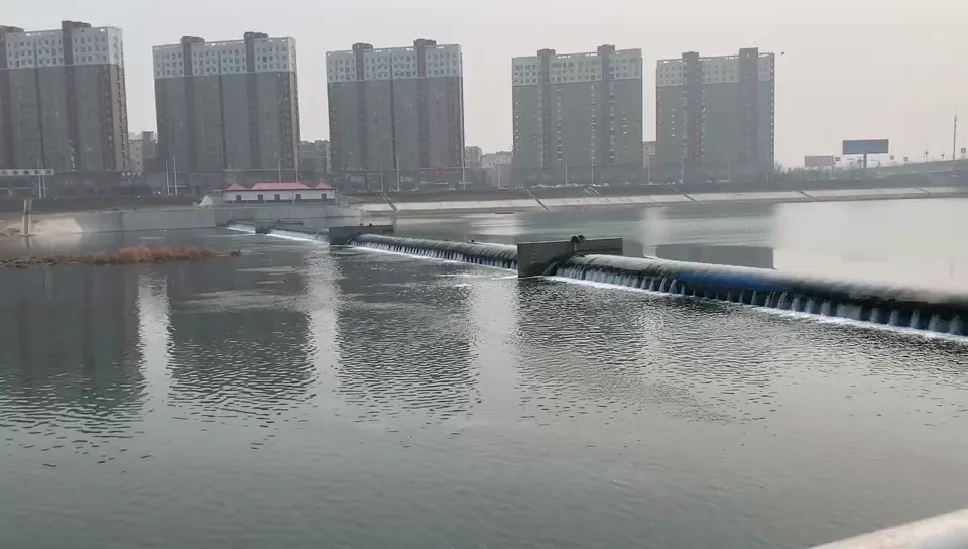
A rubber dam is a fabric-reinforced elastomer bag anchored to a flat concrete sill. Raising the weir means pumping water (or air) into the bag; passing a flood means deflating it, so the bag lies flat on the base and the river flows across the crest with almost no obstruction. There are no piers, no hoist bridge, no intermediate machinery — just one continuous flexible span.
A steel gate (radial, slide or flap) is a rigid leaf moved by hoists between concrete piers. It offers precise control at any opening position and can be engineered for heads far above the rubber dam range, but every pier narrows the channel and every hoist is a mechanical asset to maintain.
Head-to-head comparison
Set the two side by side on the criteria that decide a real project — clear span, retaining height, civil volume, hoist machinery, raise-and-lower speed, overflow behaviour, winter operation, maintenance load and whole-life cost — and the field splits cleanly: the steel gate takes the high heads and the short spans, the rubber dam takes the wide rivers and the modest heads.
Where the rubber dam wins
The rubber dam’s advantage grows with width and falls with height. If your site matches the profile below, the economics are rarely close:
✓ Choose a rubber dam when…
- The river is wide and shallow — one span up to ~135 m avoids piers entirely (multi-bay layouts like Shanhaiguan’s 17 spans × 1,428 m also work well)
- Retaining height is ≤ 6 m
- The purpose is storage, irrigation, landscape or flood passing rather than fine flow metering
- You want the channel fully recovered in flood season
- Civil-works budget is tight — no piers, no hoist bridge, shorter construction period
↗ A steel gate still makes sense when…
- Head is well above 6 m or the site is a vertical drop structure
- You need precise intermediate openings for regulated release (environmental flow, sediment sluicing per gate)
- The structure must also carry a road or service bridge deck on fixed piers
- Regulation is infrequent and hoist power is cheap — mechanical simplicity wins
Two questions that settle it
- How high must the water stand? Above the 6 m class you are already outside the standard rubber dam series; steel becomes the default. Between 1 and 6 m, rubber is fully in its element — the whole Baoli JBD ladder from 1.0 m to 6.0 m is pre-engineered.
- How wide is the river, and what must happen in flood? If the answer is “several hundred metres, and the channel must pass flood water cleanly”, piers are the enemy — and only a rubber dam eliminates them. Yucheng’s single 135 m opening did exactly that on a plain river in Shandong.
Rule of thumb
Low head + wide river + lay-flat flood requirement → rubber dam. High head + narrow opening + precise per-gate control → steel gate. Mixed sites — for example a landscape reach with an adjacent sluice — often combine both.
Not sure which side of the line your river falls on?
Send us the cross-section and objectives. We will come back with the recommended dam class, bag model and anchoring layout — and reference projects comparable to yours.