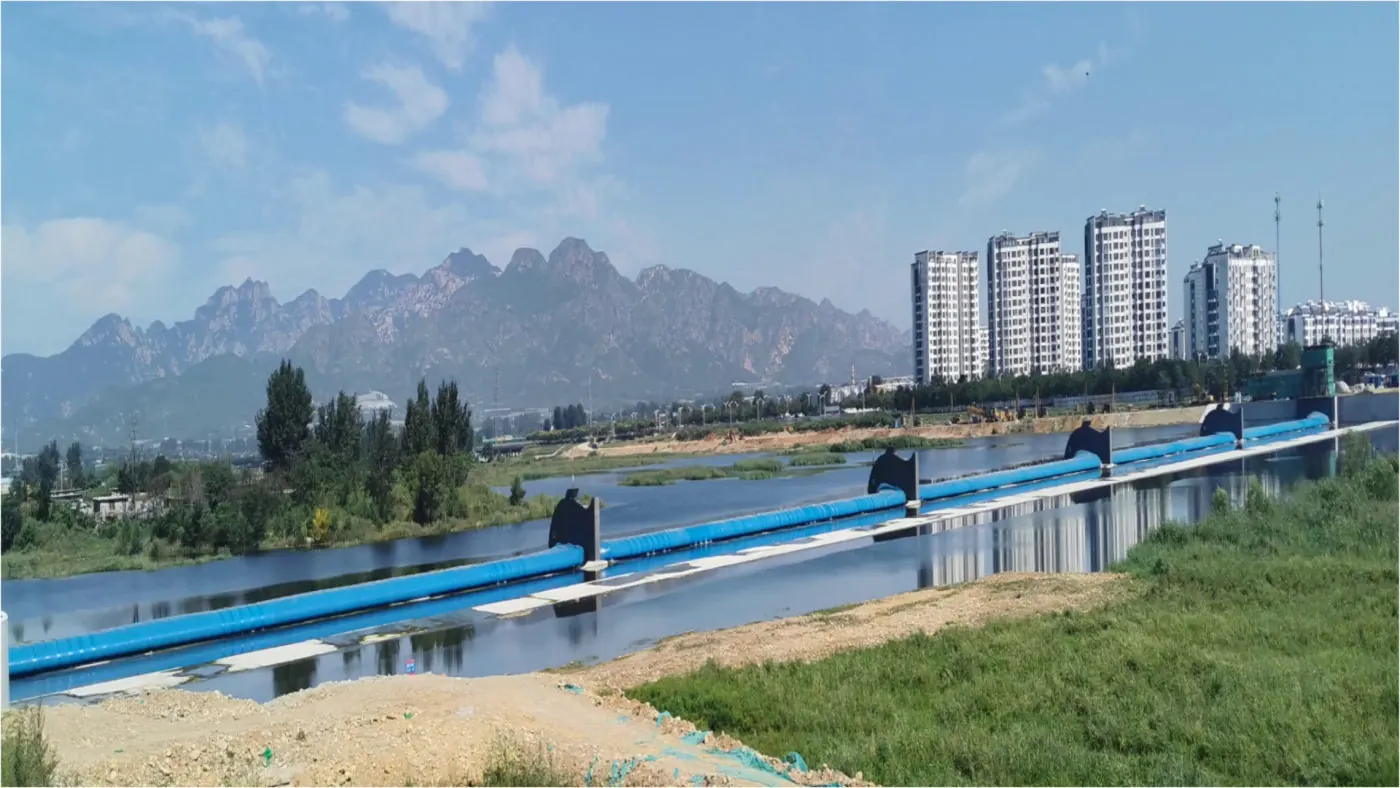
4 m water-retaining height · 1,428 m total length · North China
| Project name | Shanhaiguan |
|---|---|
| Project location | Shanhaiguan, Qinhuangdao, Hebei, China |
| Region | North China |
| Dam type | Rubber dam — fabric-reinforced inflatable dam bag |
| Dam design | Baoli (in-house design & manufacture) |
| Water-retaining height | 4 m |
| Spans / openings | 17 |
| Max single span | On request |
| Total length | 1,428 m |
| Application | Coastal river regulation · Flood control · Waterfront landscape |
| Dam bag series | JBD series, 0.5–6 m height range |
| Drawings & test reports | Available on request |
An extra-long multi-opening rubber dam hub for coastal-city river regulation. The modular multi-unit layout adapts to complex coastal hydrology and provides continuous water storage, flood discharge and waterfront landscape for the Shanhaiguan historic district — a landmark large-scale project in North China.
Water-retaining height
Total dam length
Spans / openings
Project region
Coastal rivers around Qinhuangdao carry sand off the hills in storm season and lose it again to the sea in calm weather, so the channel bed keeps moving. A retaining structure over 1.4 km long must stay sealed on shifting foundations and survive storm surge from the Bohai.
The answer is a long series of standard 4 m bays rather than one heroic span. Each bay anchors to its own sill section, so settlement or scour under one part of the line is repaired locally without draining the whole pool. Bays near the estuary can be dropped first when a surge threatens, opening the channel while upstream bays hold the landscape level. And because a rubber dam carries its load as membrane tension, not as a stiff beam, the 1,428 m structure flexes with the riverbed instead of fighting it — the property that makes kilometre-scale soft dams possible at all.
Two details decide how a very long line goes together. At the ends, where the bag turns up into the side walls, the anchorage is a bulkhead detail: the skirt is fixed first, then the run is closed from the centre outward so no slack gathers in the corner. Along the run, joints are placed where the clamp plates butt together, and the rolled core inside the fabric is set so that its seam does not sit under a plate joint. A joint over a joint leaves a soft spot that weeps under head.
A line of this length is served by more than one pump set, grouped in a control room on the bank. The sets are started in sequence and the valves at each bay are trimmed so that the bag rises evenly rather than filling from the nearest inlet outward. Instrumentation reports bag pressure and water level back to the room, and the same panel closes the inlets at the set point and opens the outlets when a drawdown is called. For the operator the whole kilometre behaves as one element, not as a row of separate dams.
This reference project used our rubber dam system — fabric-reinforced dam bag with bolt or wedge anchoring, water-filled or air-filled operation.
Considering an air shield dam instead? Compare the two systems before you specify.
We can share detailed drawings, material test reports and owner contacts for projects comparable to yours.
Tell us your river width, required water-retaining height and site conditions — we will send comparable project records and a preliminary configuration.