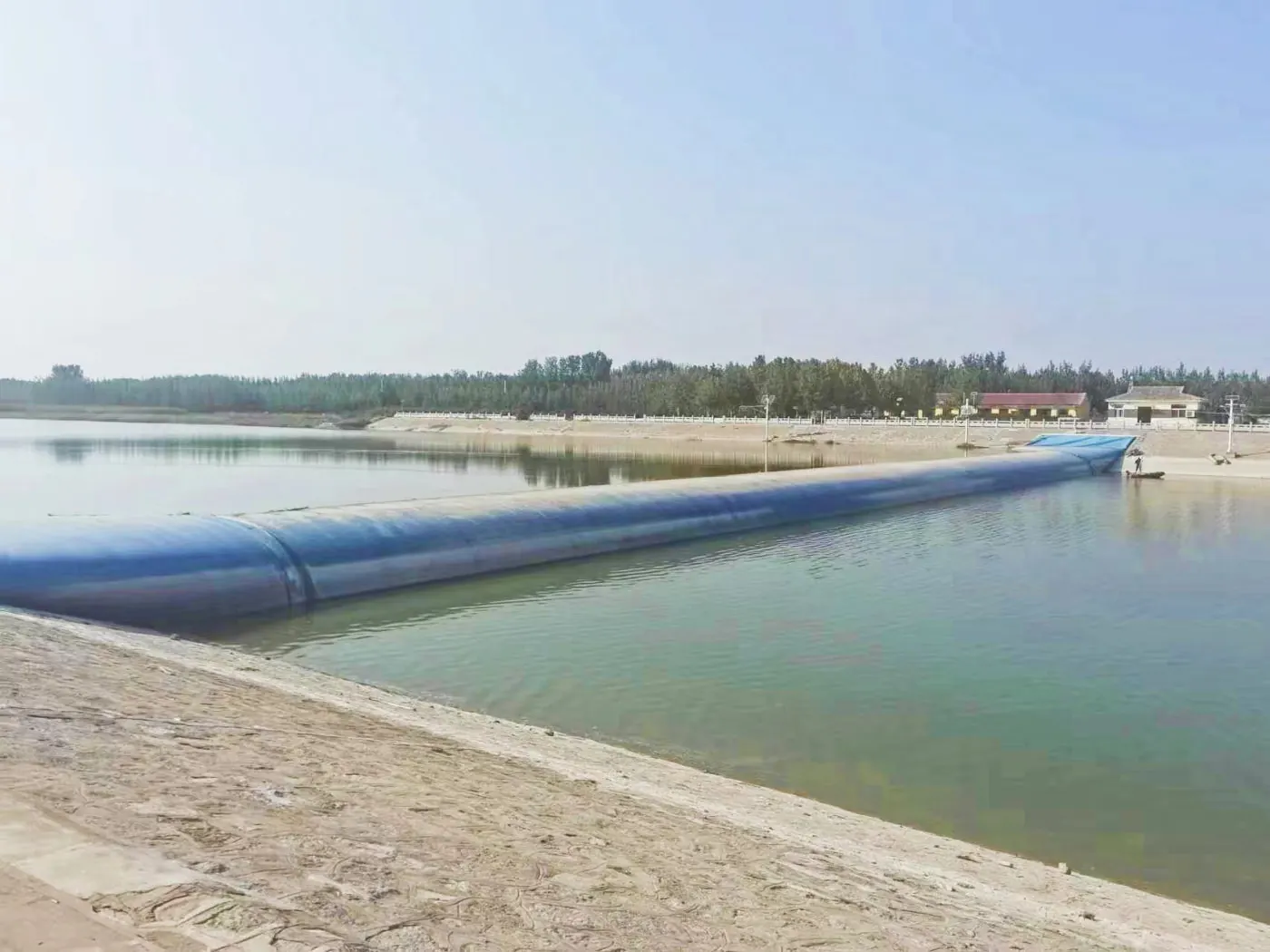
5 m water-retaining height · 135 m total length · North China
| Project name | Yucheng |
|---|---|
| Project location | Yucheng, Shandong, China |
| Region | North China |
| Dam type | Rubber dam — fabric-reinforced inflatable dam bag |
| Dam design | Baoli (in-house design & manufacture) |
| Water-retaining height | 5 m |
| Spans / openings | 1 |
| Max single span | 135 m |
| Total length | 135 m |
| Application | Water storage · Agricultural irrigation · Flood discharge |
| Dam bag series | JBD series, 0.5–6 m height range |
| Drawings & test reports | Available on request |
A remarkable large-single-opening rubber dam for plain river regulation. Supports river water storage, agricultural irrigation and flood discharge. The robust structure adapts well to flat-terrain river-valley conditions — a typical reference for northern plain-river applications.
Water-retaining height
Total dam length
Spans / openings
Project region
Rivers on the North China Plain barely fall at all — at Yucheng the channel is wide, shallow and sleepy, and the design problem is not surviving floods but lifting a useful irrigation pool on a gradient measured in centimetres per kilometre.
The project answered with a single-opening 135 m span — no intermediate piers in the channel. On a plain river every pier collects trash and reduces flow, and a single 5 m bag spanning the full width forms a clean, uniform weir that the irrigation intakes downstream can rely on. The single-span bag is vulcanised with seamless-overlap joints to the full 135 m length, then anchored as one continuous clamp line: seamless-overlap jointing means fewer seams than conventional sectioned bags, and the whole structure reads as exactly what it is — one engineered bag doing one plain-river job, storage in the dry season, full flat discharge when the summer rain finally comes.
Unfolding the bag is the step where a good installation is either made or lost. The bag is laid out over the underlay and aligned to the downstream anchor line and centre line first, then brought forward until it meets the upstream line and centre line exactly. Working from the middle outward in both directions keeps the fabric even across the width. If the bag is pulled into position from one end, the surplus gathers at the far end, and that is where the first wrinkle forms when the dam is filled.
For an irrigation dam the operating year is a schedule. Through the growing season the bag is held at the head the canal command needs, raised as the river drops and lowered as it rises, so the pool stays inside its banks. Ahead of the flood season it is deflated and left flat, and the reach runs at natural section until the peak has passed. The dam stores water when water is scarce and stops being an obstruction when it is not, which is the simplest brief a dam can have and the one that suits a plain river best.
This reference project used our rubber dam system — fabric-reinforced dam bag with bolt or wedge anchoring, water-filled or air-filled operation.
Considering an air shield dam instead? Compare the two systems before you specify.
We can share detailed drawings, material test reports and owner contacts for projects comparable to yours.
Tell us your river width, required water-retaining height and site conditions — we will send comparable project records and a preliminary configuration.