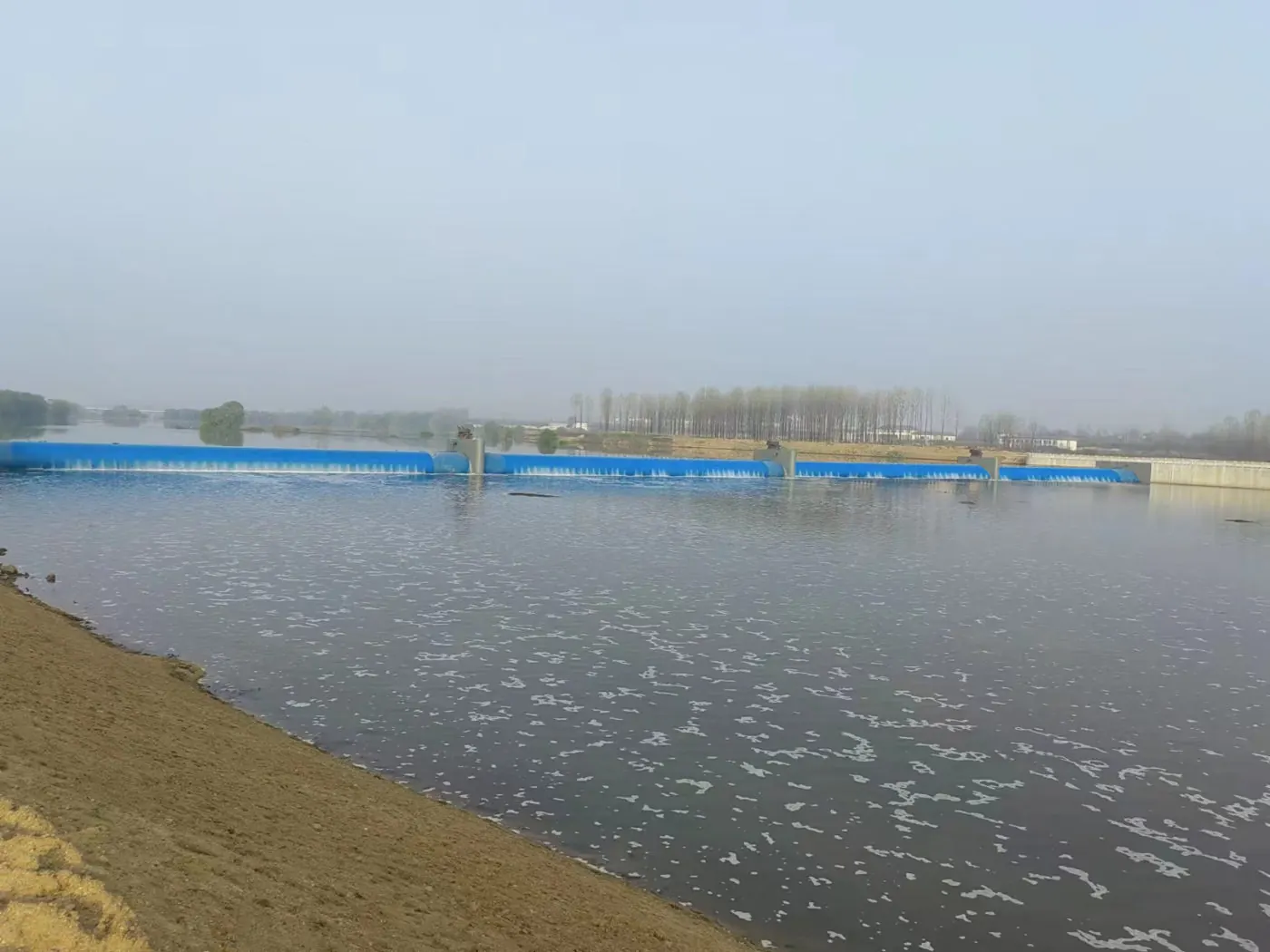
3.5 m water-retaining height · 950 m total length · Central China
| Project name | Shihe River |
|---|---|
| Project location | Shihe River, Xinyang, Henan, China |
| Region | Central China |
| Dam type | Rubber dam — fabric-reinforced inflatable dam bag |
| Dam design | Baoli (in-house design & manufacture) |
| Water-retaining height | 3.5 m |
| Spans / openings | On request |
| Max single span | On request |
| Total length | 950 m |
| Application | Urban river renovation · Flood control · Water allocation |
| Dam bag series | JBD series, 0.5–6 m height range |
| Drawings & test reports | Available on request |
A multi-span rubber dam for urban river renovation and flood control. Provides water storage, landscape improvement and water allocation. Modular bays allow independent inflation and deflation for flexible water-level control — a landmark water-conservancy project of the Xinyang Shihe River.
Water-retaining height
Total dam length
Spans / openings
Project region
The Shihe flows off the Tongbai mountains into the Huai plain at Xinyang — a region famous for concentrated summer rainstorms. A 950 m dam sits across the exact point where steep hill flow meets flat city reach, and it has to serve both flood defence and everyday water allocation.
The dam runs the river in two modes. Through the dry months it holds a 3.5 m pool that feeds intakes and keeps the urban reach alive; when storm cells sit over the mountains, the bays deflate from the banks inward, and the river is handed back nearly its full natural section before the peak arrives. Between modes the structure takes repeated fill-drain cycles — exactly the duty the bag's fabric build and full-face anchorage are designed for, with the sealing line clamped uniformly along every metre of the 950 m axis so no bay is the weak link.
On a reach that already carries dams, a new structure has to fit the water levels its neighbours create. The pool above each dam sets the tailwater for the one below it, so the working head of a bag is decided by the whole chain rather than by the bag alone. Installation follows the same datum used for the existing structures, and the corner detail where slab meets wall is formed to the groove level, so the fabric follows the radius without being pre-stressed into it.
Operation follows the same logic. Filling is done stage by stage so that each pool backs up onto a structure that is already holding, and drawdown is done from the downstream end upward, which gives the reach its maximum section before the peak arrives instead of releasing a wave into a pool that has not yet emptied. Between floods, levels are trimmed structure by structure to keep the designed water surface continuous through the city.
This reference project used our rubber dam system — fabric-reinforced dam bag with bolt or wedge anchoring, water-filled or air-filled operation.
Considering an air shield dam instead? Compare the two systems before you specify.
We can share detailed drawings, material test reports and owner contacts for projects comparable to yours.
Tell us your river width, required water-retaining height and site conditions — we will send comparable project records and a preliminary configuration.