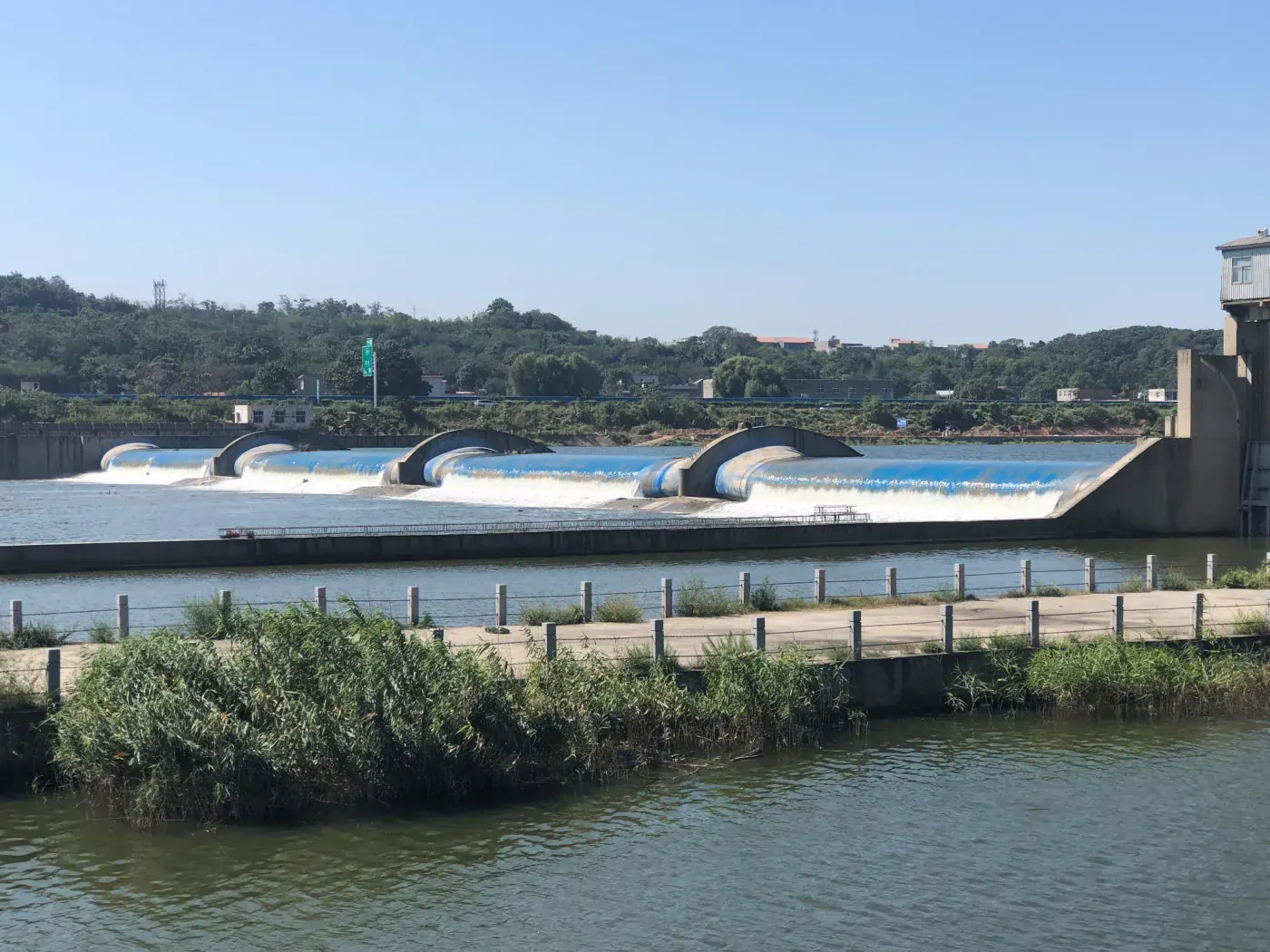
4.5 m water-retaining height · 230 m total length · Central China
| Project name | Wulong, Yiluo River |
|---|---|
| Project location | Wulong, Yiluo River, Henan, China |
| Region | Central China |
| Dam type | Rubber dam — fabric-reinforced inflatable dam bag |
| Dam design | Baoli (in-house design & manufacture) |
| Water-retaining height | 4.5 m |
| Spans / openings | On request |
| Max single span | On request |
| Total length | 230 m |
| Application | Regional flood control · Water storage · Water-level regulation |
| Dam bag series | JBD series, 0.5–6 m height range |
| Drawings & test reports | Available on request |
A multi-span coordinated rubber dam for hilly river regulation. Independent spans enable flexible joint operation for variable water levels, supporting regional flood control and water storage across the Yiluo River basin.
Water-retaining height
Total dam length
Spans / openings
Project region
The Yiluo system inherits the Yellow River's defining problem: water that arrives thick with loess sediment. Any dam that ponds the flow too deep lets that load settle against the face, and the storage dies within seasons.
This line is run as a flushing structure first and a storage dam second. The 4.5 m crest holds a working pool for flood-season storage and level regulation, but the operating schedule drops the bays on a rhythm matched to the sediment cycle — releasing accumulated silt downstream while it is still in motion instead of letting it build. Bag and anchorage at this height class use a heavy fabric build matched to the class, because a sediment-charged flow is an abrasive flow. The payoff is a dam on a tributary most engineers would write off, built to keep trading water and passing sediment for the long term.
Where the slab is formed with an anchor groove, the bag can be held by a concrete wedge instead of by bolts. The fabric and the underlay are rolled around a core and pushed into the groove, then front and rear wedges are driven in alternately and hammered until the rear wedge reaches its depth and the fabric is pinched tight. The core is what keeps the fabric from being cut by the wedge, and it is why the detail survives the movement a bag makes each time it fills and empties.
A high bag has less margin than a low one, and the operating rules reflect that. It is kept within the height and pressure it was designed for, never over-filled to gain a little more head, and it is filled and emptied with the outlet path clear. A one-way dam is not used to hold water from the downstream side: the bag is built to take head on one face, and reversing it puts the clamp line under a load it was never shaped for.
This reference project used our rubber dam system — fabric-reinforced dam bag with bolt or wedge anchoring, water-filled or air-filled operation.
Considering an air shield dam instead? Compare the two systems before you specify.
We can share detailed drawings, material test reports and owner contacts for projects comparable to yours.
Tell us your river width, required water-retaining height and site conditions — we will send comparable project records and a preliminary configuration.