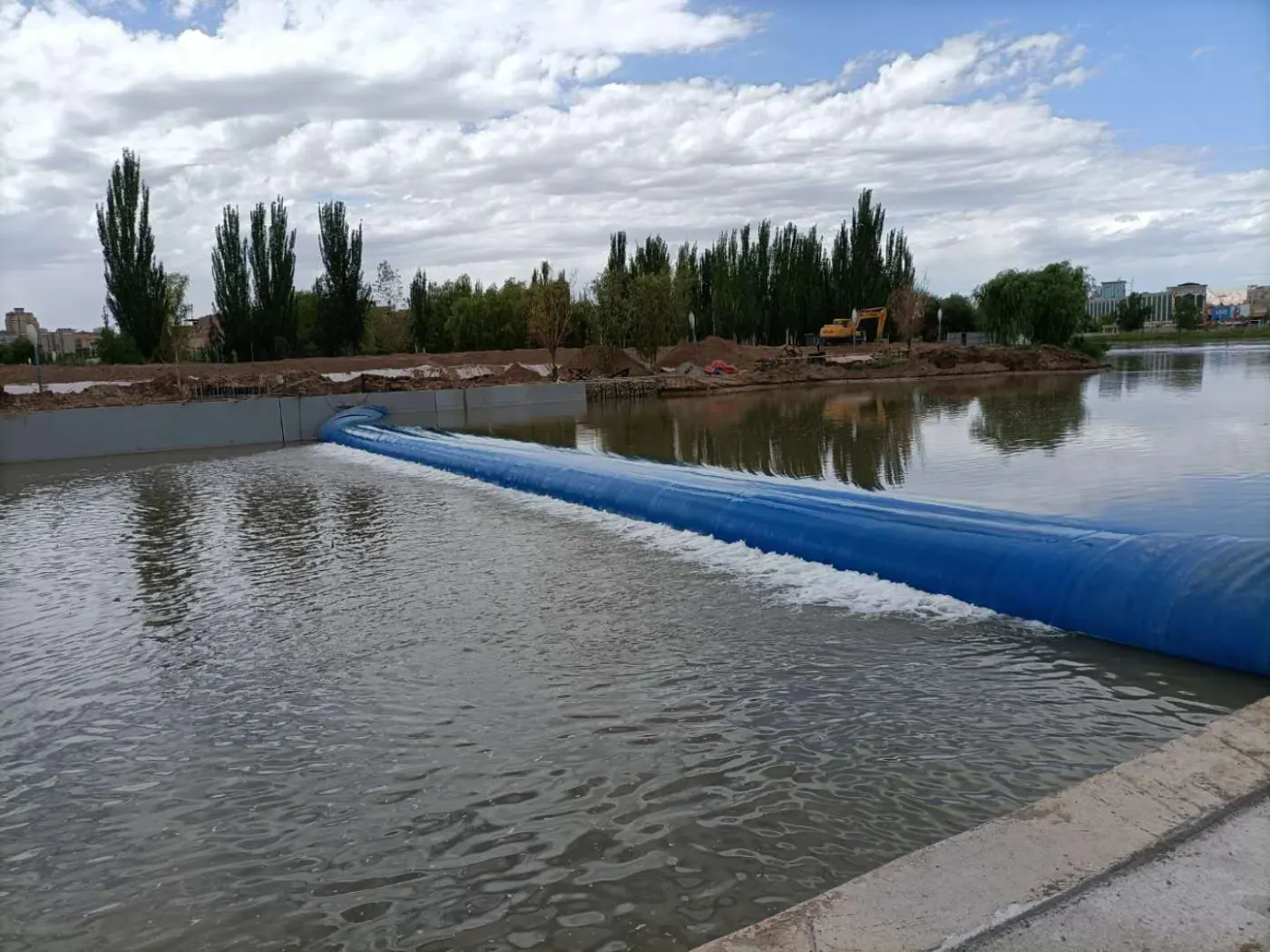
2.5 m water-retaining height · 75 m total length · Northwest China
| Project name | Tuman River |
|---|---|
| Project location | Tuman River, Kashgar, Xinjiang, China |
| Region | Northwest China |
| Dam type | Rubber dam — fabric-reinforced inflatable dam bag |
| Dam design | Baoli (in-house design & manufacture) |
| Water-retaining height | 2.5 m |
| Spans / openings | On request |
| Max single span | On request |
| Total length | 75 m |
| Application | Arid-region water management · Flood control · Ecological restoration |
| Dam bag series | JBD series, 0.5–6 m height range |
| Drawings & test reports | Available on request |
An urban-river rubber dam for arid-region water management and flood control. Offers water storage, ecological restoration and urban landscape enhancement. The modular bay design supports independent inflation and deflation for water-level adjustment — a key municipal water-conservancy project in Kashgar.
Water-retaining height
Total dam length
Spans / openings
Project region
The Tuman River at Kashgar is fed by snow and glacier melt off the Pamirs: flows surge with summer melt and shrink to a trickle in autumn, and what water does arrive arrives gritty with mountain sediment.
The dam's job is to hold each day's melt long enough to feed canals and recharge the riverside oasis belt, then give the channel back when the sediment-laden peak comes. The 2.5 m crest steps the river down gently rather than ponding it deep — which keeps suspended load moving instead of settling in front of the dam. Deflation passes the flush. Intense UV at this inland latitude is met with the bag's three-layer compound system — an outer layer built for abrasion and weathering, a middle layer that protects the canvas skeleton, and an inner layer that keeps the bag airtight — and the compact 75 m line is easy for a local crew to operate.
On a silt-laden river the clamp line has to be right the first time, because re-working it means dewatering the site again. Bolts are run down with a torque wrench to a set value, one after another along the plate, and the line is tightened again once the first filling has bedded the fabric. Plates that do not sit level are packed rather than forced, since a plate pulled down onto a high spot leaves the bag pinched beside it.
A deflated bag on this river is a buried bag. Silt settles on it through the low-flow season, and the first filling afterwards has to lift that load. The bag is therefore raised in several steps, pausing while the fabric works its way out of the deposit, instead of being filled against the full weight at once. Where the cover is deep, the silt is cleared by hand before filling, and the clearing is done with tools that cannot score the rubber. It is slow work, and it is why a low bag on a sandy river lasts.
This reference project used our rubber dam system — fabric-reinforced dam bag with bolt or wedge anchoring, water-filled or air-filled operation.
Considering an air shield dam instead? Compare the two systems before you specify.
We can share detailed drawings, material test reports and owner contacts for projects comparable to yours.
Tell us your river width, required water-retaining height and site conditions — we will send comparable project records and a preliminary configuration.