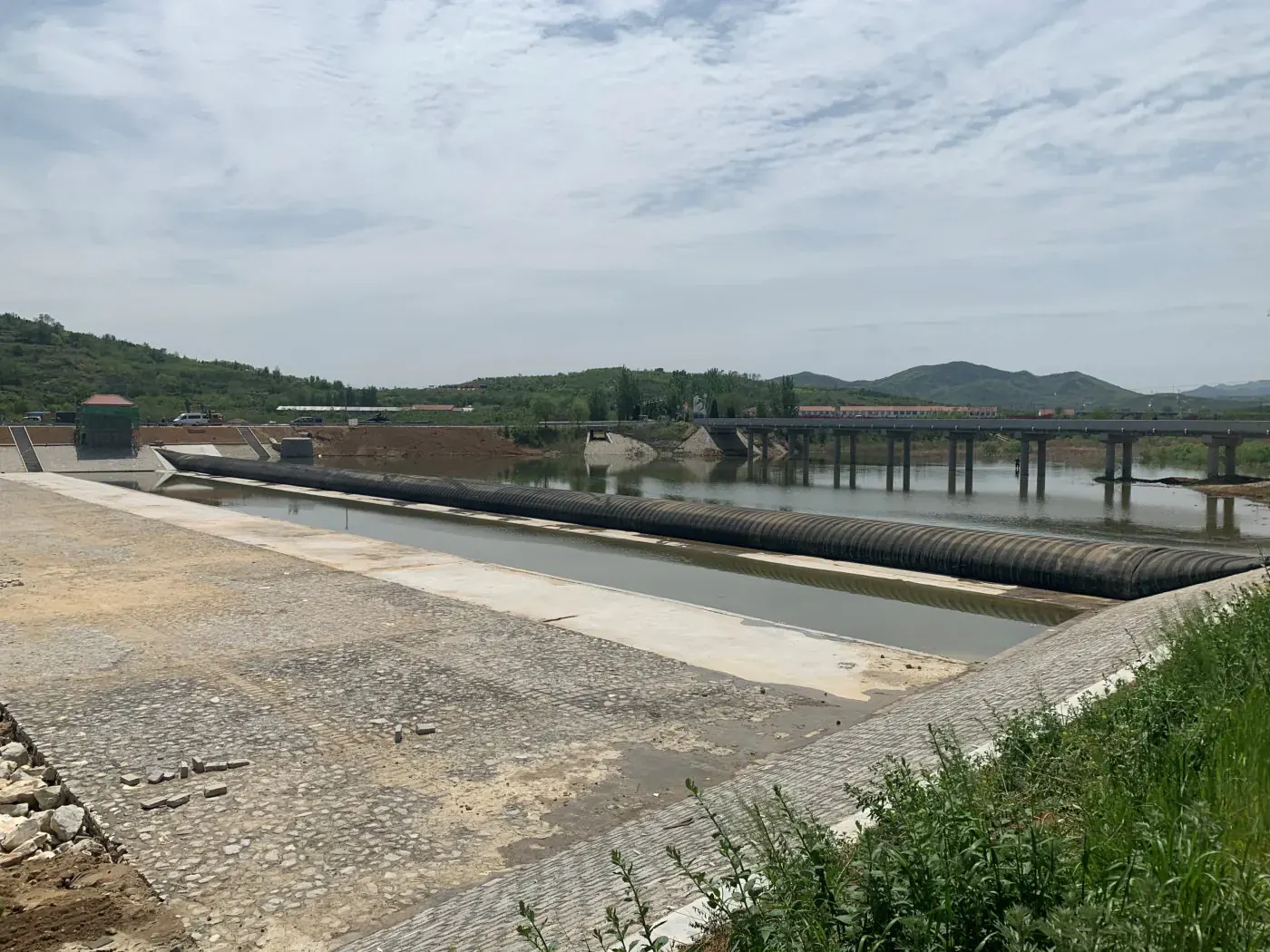
3 m water-retaining height · 168 m total length · North China
| Project name | Taolin |
|---|---|
| Project location | Taolin, Yantai, Shandong, China |
| Region | North China |
| Dam type | Rubber dam — fabric-reinforced inflatable dam bag |
| Dam design | Baoli (in-house design & manufacture) |
| Water-retaining height | 3 m |
| Spans / openings | On request |
| Max single span | On request |
| Total length | 168 m |
| Application | Water supply · Irrigation · Riparian ecological improvement |
| Dam bag series | JBD series, 0.5–6 m height range |
| Drawings & test reports | Available on request |
A large-scale rubber dam for mountain-river management and flood control. Features water storage, irrigation and riparian ecological improvement, with modular bays supporting independent inflation and deflation for water-level adjustment — a key local water-conservancy project in Yantai.
Water-retaining height
Total dam length
Spans / openings
Project region
The Shandong peninsula concentrates most of its rain into a few summer weeks, then runs dry through spring. Orchard and field irrigation around Yantai depends on capturing that brief wet-season flow and rationing it over months.
A 3 m rubber dam turns the river reach itself into the reservoir — no farmland drowned, no dam lake evaporation, and the pool refills each summer in place. Bays near the irrigation intakes can be raised first each season, with the line stepping up as inflow allows, so stored water is allocated step by step rather than all at once. The low crest was chosen to match the valley: high enough to bank the season's flow against the dry months, low enough that the rare typhoon flood tops and passes the deflated line without ever threatening the orchards it serves.
A dam feeding a supply network cannot be allowed to leak at the clamp line, so the sealing detail gets attention before anything else. The sealing strip is bonded to the underlay at the works and kept in place through installation instead of being laid loose, and the underlay is fixed into the anchor groove and up the walls before the bag is unfolded over it. Outlets are cut to the positions found on site and reinforced around the opening, so the water cap seats on sound sheet rather than on a raw edge.
The routine that keeps a supply dam available is short, and it is carried out before every filling. The bag surface is walked and checked for cuts and chafing, particularly where it meets the slab and at the end skirts. Anchors are checked for looseness and corrosion, the inlet and outlet valves for freedom of movement, and the overflow and pressure protection for correct operation. A dam that passes this check can be relied on to hold the pool the intake depends on; a dam that has skipped it is a scheduled outage waiting to happen.
This reference project used our rubber dam system — fabric-reinforced dam bag with bolt or wedge anchoring, water-filled or air-filled operation.
Considering an air shield dam instead? Compare the two systems before you specify.
We can share detailed drawings, material test reports and owner contacts for projects comparable to yours.
Tell us your river width, required water-retaining height and site conditions — we will send comparable project records and a preliminary configuration.